Monthly Archives: September 2026

How to evaluate Indian veterinary pharmaceutical companies

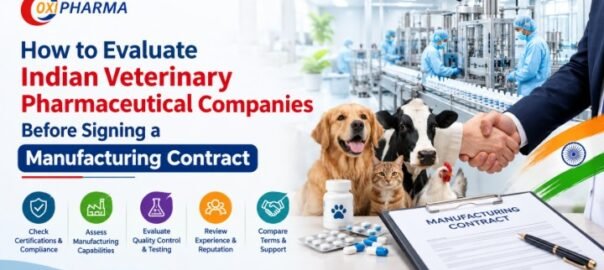
How to Evaluate Indian Veterinary Pharmaceutical Companies Before Signing a Manufacturing Contract ?

The Indian veterinary pharmaceutical industry is quite large and growing, with major activity being available in the states of Punjab, Haryana, Himachal Pradesh, Gujarat, and Maharashtra. The top Indian veterinary pharmaceutical companies go beyond the three points outlined above by having the right manufacturing or PCD (paid company dealing) that is trusted, followed by a wide range of lines on livestock, poultry, pet care, and a certification from WHO-GMP (World Health Organization Good Manufacturing Practice). This guide addresses the products of such manufacturers, the certifications that need to be checked, and how to pick the correct partner for your projects.

Why Choose Indian Veterinary Pharmaceutical Companies?

WHO-GMP Certified Production

All major veterinary drug manufacturers in India are working under WHO-GMP (Good Manufacturing Practices) Norms, providing batch-to-batch consistency, quality, and hygiene.

Cost-Competitive Manufacturing

Indian manufacturing base allows for meaningfully lower production costs, reducing expenses without sacrificing WHO-GMP compliance; a crucial factor behind Indian veterinary medicine suppliers’ competitiveness in Indian and global markets.

Wide & Flexible Product Range

Indian manufacturers have a wide range from simple to complex, OTC to bio-supportive formulations. PetVet Healthcare has a wide selection of SKUs to cater to various requirements.

Export Capability

The Indian veterinary pharma export market covers several regions such as Africa, Southeast and Middle East, where the international buyers’ demands are generally for WHO-GMP certification to enter the export market.

Third Party Manufacturing / Contract Manufacturing

India’s well-established contract manufacturing ecosystem. Third-party veterinary manufacturing arrangements can be effective ways for entrepreneurs to establish their own veterinary brand with relatively low investment.

Strong Regulatory Framework

The veterinary medicines are regulated by drug authorities both in the Centre (Central Drugs Standard Control Organisation – CDSCO) and in the State and their compliance with drug laws and safety of the product are ensured.

Process Of Selecting the Top Veterinary Pharmaceutical Companies in India

Step 1: Verify Licenses and Certifications

Ask them for copies of their Drug Manufacturing Licence, WHO-GMP certificate, and any necessary export certificates — valid dates to be checked.

Step 2: Evaluate Product Range

A manufacturer who has a wide range of products (injection, liquid by mouth, powder, bolus, topical) is more flexible in the future expansion of your business.

Step 3: Assess Quality Control Systems

Inquire about their own QC laboratory, testing procedures, stability testing, and batch release.

Step 4: Review Market reputation.

Seek out brand names that have been proven to be successful and find out from current distributors/franchise partners for recommendations.

Step 5: Preparation task

When comparing prices with different manufacturers, know the minimum order quantities (MOQ) and payment terms before the order by asking the questions upfront.

Step 6: Evaluate Logistics & Distribution Support

Ensure that the manufacturer offers marketing materials, promotion, and firm delivery dates.

Step 7: Third-Party Manufacturing Terms

If you desire your own brand and additional third-party/private label manufacturing options, get details on lead times and exclusivity clauses.

Why is Oxi Pharma one of the top veterinary pharmaceutical companies in India?

These are the number of reasons why is it one of the top veterinary medicine companies in india

They offer:

  • An extensive line of products for animals such as livestock, poultry and pets.
  • Custom machine tool manufacturing by a third party.Third-party manufacture of custom brands.
  • Delivers an exclusive, monopoly-based distribution policy.Provides an exclusive future distribution policy based on a monopoly basis.
  • WHO-GMP Certified Manufacturing Facility
  • Manufactured and distributed products throughout India.
  • Products available throughout India with assistance.

Conclusion

Shooting off your brand in India isn’t difficult – if you have the correct manufacturing spouse. Make sure you one of the top Indian veterinary pharmaceutical companies like Oxi Pharma that not only supplies but supports as well. Now, it’s time to take the spotlight as you shine in the booming veterinary industry in India. Just make sure you work with the correct folks.

Frequently Asked Questions

Q1. Is it possible to launch a top 10 veterinary medicine company in india without a manufacturing plant?

Yes, by third-party manufacturing (contract manufacturing). You can approach a licensed veterinary pharma manufacturer, state your brand needs, and they will create products under your label.

Q2. Which are the best veterinary industrialised products of India?

The main categories consist of anti-infectives and antibiotics, anti-parasitic drugs (dewormer, tick control), vaccines and biologicals, nutritional supplements and minerals, liver and intestinal health products, hormonal drugs, feed additives and aquaculture medicines.

Q3. In how many states are veterinarians found manufacturing in India?

The most important part of manufacturing veterinary medicines can be found in the Baddi belt of Himachal Pradesh, along with the states of Punjab, Haryana, Gujarat and Maharashtra.

Q4. Does the export of veterinary medicines take place in the international market in India?

Yes. Exports from Indian manufacturers are to various countries in Africa, Southeast Asia, and the Middle East. Usually, it is necessary to be W.H.O-GMP certified to satisfy international buyers and official requirements.
Vet Third Party Manufacturer Checklist

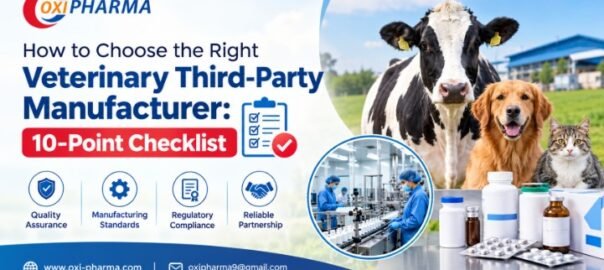
How to Choose the Right Third Party Veterinary Medicine Manufacturer: 10-Point Checklist

The veterinary pharmaceutical industry is expanding, and there is an increasing need for quality pharmaceuticals, supplements, and products for the health of animals. Veterinary third-party manufacturing is a potentially efficient way to develop and launch new products for poultry farmers, poultry distributors, sheep producers, PCD companies, and other new brand producers without capital investment in developing in-house manufacturing.

There are many things to consider when selecting your third party veterinary medicine manufacturer, but careful consideration is vital. It could affect your product, manufacturer standards, required documentation, formulation skills and capabilities, product price you will need to set, and the delivery schedule. A good third-party veterinary manufacturing company will not only be able to produce your products, but they guarantee they will also help ensure consistency and a steady supply.

10 Point Checklist To Check The Right Veterinary Third-Party Manufacturer

This is a 10-point checklist that can be applied to the selection of the right veterinary third-party manufacturers.

1. List required Licences and Certifications.

Firstly, it is important to check if the manufacturer has all pertinent licences and certifications to manufacture veterinary pharmaceutical products. Do not take up an order without manufacturing licences or a quality certificate.

  • The products can be made under different types of documentation/regulation. 

2. Ensure that the data supports validation of the Third-Party Veterinary Pharma Manufacturer’s experience:

The third-party veterinary pharma manufacturer who has experience in producing veterinary products will be acquainted with the formulation requirements, manufacturing processes, packaging, documentation, and market expectations.

Take into account the company’s experience, the products covered, their manufacturing ability, and their pharmaceutical industry experience. This will help you to decide whether or not the manufacturer is the correct one for your needs.

3. Check the Veterinary Product Portfolio.

The wider the scope of products, then it is more likely that the business will have more opportunities for growth of its veterinary branding in the future. The portfolio will be modified as per the manufacturer’s capacity:

  • Tablets are used in a vet office or a clinic; they come in capsules.
  • Liquid therapies for the mouth area (orals).
  • Powders 
  • Injections
  • Feed supplements
  • Nutritional products
  • Topical preparations

4. Give clients recommendations on Custom Formulation and Product Development service.

Product types can vary from business to business. Established formulations may be preferred by some, and customized formulations and strengths, or packaging, flavour, dosage forms, etc. may be needed by others.

Before choosing a manufacturer, find out if they provide some formulation assistance and customization. Proper technical and research and development abilities can be especially handy when companies go into creating differentiated products.

5. Third-party manufacturing capacity for veterinary pharmaceuticals is evaluated. 

Another crucial factor to take into consideration is the Veterinary pharmaceutical third-party manufacturing plant. Production by a professional 3rd party is expected to have an appropriate production area, equipment, procedures to store the material, and a quality-control system, as well as trained staff that are in place.

Evaluate the production capacity, hygiene, raw materials, storage of finished production, batch management, and quality control laboratory of the facility, wherever possible.

6. Examine Quality-Control Practices

The quality of the product ought to be given a high priority at all times. Inquire from the manufacturer what they do to test raw materials, packaging, in-process materials, and end-of-pipe.

Appropriate test methods, records, batch records, and product release procedures should be used in an organized quality control process. Companies can ask for details regarding the documentation of the quality furnished in the finished goods.

7. Identify the various principles and techniques used in pricing products.

MOQ can affect the initial investment and requirement for inventories. For technology start-ups or those launching a new product (MOQ), the line (such as veterinary) may not be interested in numerous MoQs.

It is important to ask questions ahead of the signing process before the final agreement:

  • Minimum order quantity
  • Product-wise pricing
  • Packaging costs
  • Label requirements
  • Payment terms
  • Development charges
  • Repeat-order requirements

8. Check production/supply capacity.

Regular supply is crucial to maintain regular and robust business relationships with distributors and customers. If the manufacturing time is delayed, you may not have your product available at all, and that might impact your brand’s reputation.

Critique the production time, raw materials, stock management, production scheduling, and the production flexibility of the manufacturer in the production of quizzes for high-demand items.

9. Quality Control of Packaging & Private Label Support

It is obvious that packaging is an important part of brand packaging; the packaging of pharmaceutical products specifically is very important. Veterinary medicines can be supplied in various forms including: bottle, carton, blister pack, sachet, jar, or packaging that is appropriate for the medicinal product.

Check to determine if any private labeling, label printing, co-ordinating label branding is possible, packaging help is available, and batch coding is provided by the manufacturer. Product labels should also comply with any relevant regulations.

10. Make sure of Pricing and Documentation Transparency.

It should be a key consideration when choosing a programme. External manufacturers of good quality should have to draw the reader’s attention so that the buyer understands the price, MOQ, manufacturing period, documents, payment terms, packing, involved costs, etc. of the products.

Don’t go with the lowest quotation from a manufacturer. Instead of the manufacturer’s reputation, examine the length of the manufacturer’s business history, their communication ability, their veterinary third-party manufacturing experience, price, and compliance, and the manufacturer’s quality, not the actual product’s quality.

Conclusion

It’s important to research to pick the right veterinary third-party manufacturers like 

Oxi Pharma. It is crucial for businesses to thoroughly check the licences and certifications, industry record, product libraries, formulation ability, manufacturing facilities, quality control, MOQ (Minimum Order Quantity), supplier reliability, packaging assistance, and business transparency when selecting suppliers.

By following these ten rules, pharmaceutical companies and veterinary healthcare businesses can find a third-party veterinary manufacturing company that fits their product requirements, budget, quality objectives, and growth plans.