To choose a trusted partner for Third Party Veterinary Medicine Manufacturer, start by checking their licences, then confirm GMP compliance. Make sure they can actually produce your dosage forms, and go through their quality control and stability data yourself. Get MOQ, pricing and intellectual property terms in writing and compare them side by side. Don’t sign anything until you’ve read every audit-ready document listed at the end of this guide.
Own a veterinary health brand, run a PCD pharma manufacturing, or planning a private-label line as a vet? This guide is for you. Inside: a 10-point checklist, a weighted scorecard, the red flags worth walking away over, and a due-diligence document list. Use them to pick a veterinary pharmaceutical third party manufacturing you can actually rely on.
Table of Contents
- What Is a Third-Party Veterinary Medicine Manufacturer?
- The 10-Point Checklist for Vetting a Veterinary Manufacturer
- Red Flags in a 3rd Party Veterinary Manufacturer
- Documents to Request Before You Sign
- Key Requirements for 3rd Party Veterinary Medicine Manufacturer in India
- How to Evaluate Manufacturing Facilities
- FAQs
- Conclusion and Next Step
What Is a Third Party Veterinary Medicine Manufacturer?
A third-party veterinary medicine manufacturer (also called a contract manufacturer, CMO or loan-licence manufacturer) produces animal health products on behalf of another company. You own the brand, the marketing and the distribution. The manufacturer owns the plant, the equipment and the production process.
This model lets you launch without building a factory. It suits startups, PCD companies, veterinary clinics with private labels and established brands adding new SKUs.
Common Manufacturing Models
| Model | Who holds the licence | Best for | Main risk |
|---|---|---|---|
| Own plant | You | Large, established companies | High capital cost |
| Contract (third-party) manufacturing | Manufacturer, with your brand on the pack | PCD firms, brands, startups | Dependence on one supplier |
| Loan licence manufacturing | Manufacturer’s site, your loan licence | Brand owners who want a licence in their name | Shared compliance liability |
In India, veterinary drugs fall under the Drugs and Cosmetics Act, 1940 and its Rules. Manufacturing licences are issued by the state licensing authority. Other markets have their own regimes, such as the FDA Center for Veterinary Medicine in the US and the EU Veterinary Medicinal Products Regulation.
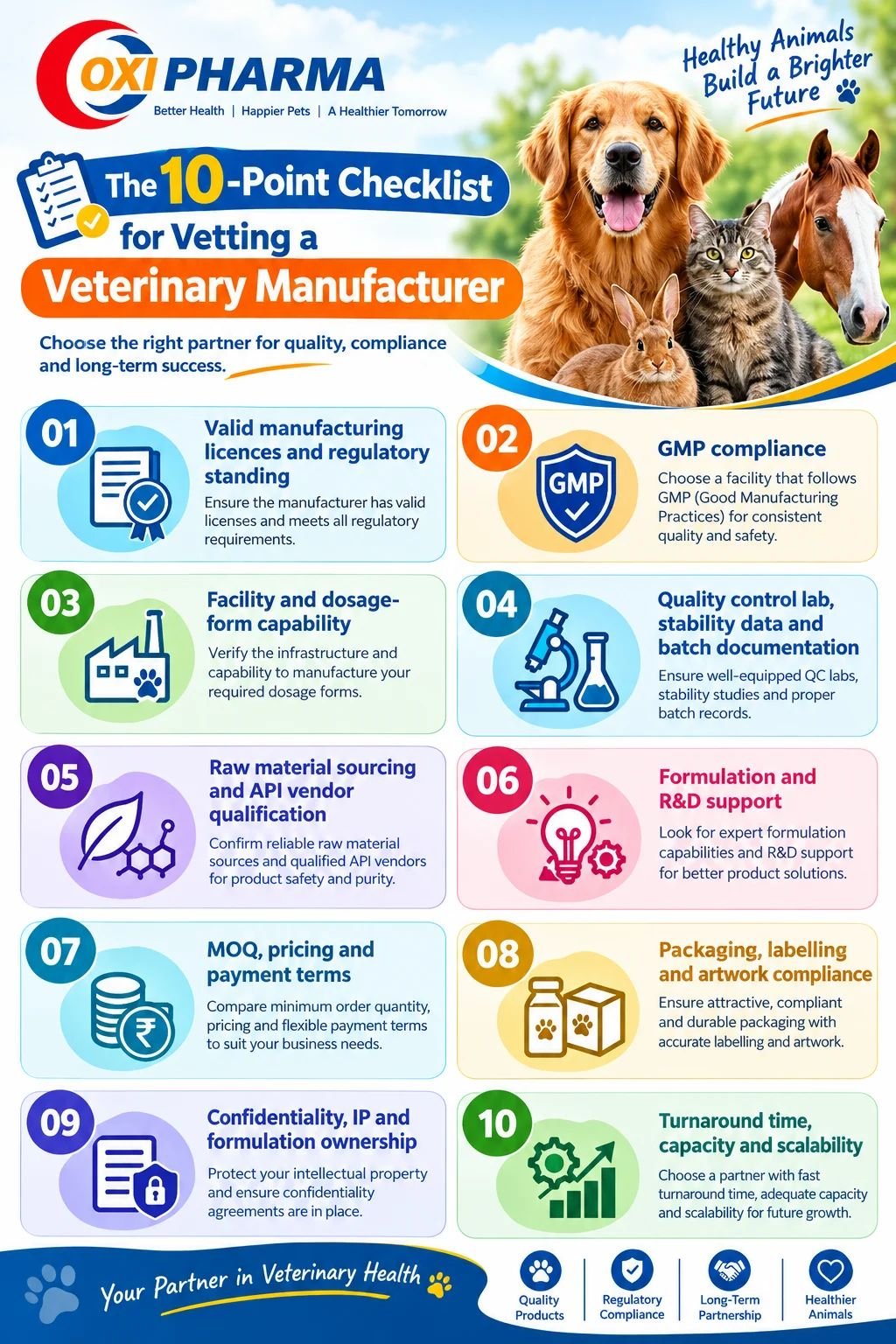
10-Point Checklist for Vetting a Third Party Veterinary Medicine Manufacturer
Use these ten checks in order. Each section stands on its own, so you can share a single point with your team.
1. Valid manufacturing licences and regulatory standing
Ask for the current manufacturing licence and confirm it covers your product category. Licences are specific. A plant licensed for general tablets may not be licensed for injectables or for certain product classes.
Check these items:
- Licence number, validity date and the products or categories listed
- Any pending inspections, show-cause notices or suspensions
- Whether the site holds a loan licence facility if you need a licence in your own name
Verify the licence with the issuing state drug authority. Do not rely on a scanned copy alone.
2. GMP compliance (revised Schedule M / WHO-GMP)
India’s Ministry of Health notified the revised Schedule M in December 2023 to align domestic Good Manufacturing Practice with WHO standards. It puts more weight on pharmaceutical quality systems, risk management, qualification and validation, and product quality review. Smaller manufacturers were given an extended transition period, so confirm the plant’s current status directly. Do not assume it is compliant.
Ask the manufacturer:
- Is the site compliant with the revised Schedule M today? Request the evidence.
- Does it hold a WHO-GMP certificate? Check the issue and expiry dates.
- What were the outcomes of its last regulatory and customer audits?
3. Facility and dosage-form capability (tablets, injectables, liquids, powders, premixes)
Not every plant can make every form. Veterinary products are especially varied: boluses, oral liquids, water-soluble powders, feed premixes, injectables and topical products all need different equipment and controls.
| Dosage form | What to verify |
|---|---|
| Tablets and boluses | Granulation, compression and coating lines; dust control |
| Oral liquids and suspensions | Mixing tanks, homogenisers, filling accuracy |
| Water-soluble powders | Blending uniformity, humidity control |
| Feed premixes | Cross-contamination controls, blend validation |
| Injectables | Sterile area classification, environmental monitoring, sterility testing |
Ask for a facility walkthrough, in person or by video. Look at the flow of materials, the cleanliness of the floor, and the separation of products.
4. Quality control lab, stability data and batch documentation
A strong QC lab tests raw materials, in-process samples and finished goods. It should own calibrated instruments such as HPLC, dissolution testers and, for injectables, sterility and endotoxin testing equipment.
Request:
- A list of QC instruments and their calibration records
- Stability data for similar products, following international guidance such as the VICH stability guidelines
- A sample Batch Manufacturing Record (BMR) and Certificate of Analysis (COA)
- Their out-of-specification (OOS) and deviation handling procedure
5. Raw material sourcing and API vendor qualification
Your product is only as good as its inputs. Ask how the manufacturer approves suppliers and tests incoming materials.
Look for:
- An approved vendor list with qualification records
- Testing of every incoming API and excipient lot, not just a review of the supplier’s COA
- Traceability from finished batch back to raw material lot
- Willingness to use your preferred API source, if you have one
6. Formulation and R&D Support
A lot of brand owners arrive with an idea and no clear way to turn it into something stable, palatable and effective. This is where veterinary formulation manufacturers with real R&D depth earn their keep. They develop products around specific animal health needs instead of just running your batches.
Ask about:
- Who’s on the in-house R&D team, how experienced they are, and which veterinary products they’ve already taken to launch
- Hands-on experience with your species: cattle, poultry, small animals, equine or aquaculture
- Help with palatability, dosage accuracy, batch consistency and shelf-life testing
- Bioequivalence studies or field-trial support, if your product needs them
One more thing to settle early: who owns the final formulation once development is done? Point 9 covers this in more detail.
7. MOQ, pricing and payment terms
Minimum order quantities (MOQ) vary widely by dosage form. Injectables and specialised forms usually have higher MOQs than powders or liquids.
Compare quotes on the same basis:
- Cost per unit, including packing material, testing and overheads
- MOQ per SKU and per batch
- Payment schedule (advance, on dispatch, credit period)
- Who pays for artwork changes, rejected batches and re-tests
Watch for very low quotes. A price far below market often means cut corners in materials or testing.
8. Packaging, labelling and artwork compliance
Veterinary labels must carry legally required information. The manufacturer should know the rules for your target market, including licence numbers, composition, withdrawal periods where applicable, storage conditions and batch details.
Confirm that they:
- Review your artwork for compliance before printing
- Offer a range of pack types (bottles, blister packs, sachets, vials, pouches)
- Control printed material with proper reconciliation to prevent mix-ups
- Handle serialisation or QR features if you want them
9. Confidentiality, IP and formulation ownership
Put this in writing before you share any formula. Your contract should state who owns the formulation, the artwork, the brand name and the data.
Include:
- A signed non-disclosure agreement (NDA)
- A clause that bars the manufacturer from making the same formula for others
- Ownership of the dossier and technical data
- Exit terms, including tech transfer if you move to another site
10. Turnaround time, capacity and scalability
Ask for realistic timelines for each stage: sampling, validation batches, first commercial batch and repeat orders. Then test their capacity.
- Standard lead time per dosage form
- Current plant utilisation (a full plant may delay you)
- Ability to scale from pilot to commercial volumes
- A contingency plan if a machine breaks down or a raw material runs short
Common Mistakes to Avoid When Selecting a Third Party Veterinary Drug Manufacturer
Walk away, or at least pause, if a third party veterinary drug manufacturer in india you’re vetting does any of this:
- Dodges when you ask to see licences, certificates or the plant itself
- Quotes prices far below market and can’t explain why
- Has no written quality agreement
- Gets vague when you ask where the API comes from
- Has no stability data for comparable products
- Says it makes “everything” at a single site
- Will make restricted or banned substances (colistin, for one, is banned for animal use in India)
- Pushes for a big advance before any audit
- Has a poor record in state drug authority “Not of Standard Quality” alerts, or can’t give you client references
Documents to Request Before You Sign
Ask for these documents during due diligence. A serious manufacturer will share most of them before signing.
Regulatory and legal
- Manufacturing licence(s) and loan licence, if applicable
- WHO-GMP certificate and revised Schedule M compliance evidence
- Latest regulatory inspection summary and audit reports
- Company registration, GST and other statutory documents
Quality and technical
- Site master file and facility layout
- List of QC instruments with calibration records
- Sample BMR, BPR and COA
- Stability study protocols and reports for comparable products
- Vendor qualification list and raw material specifications
- Deviation, OOS and change control procedures
Commercial and contractual
- Quality agreement and manufacturing agreement draft
- NDA and IP ownership clause
- Price list, MOQ and payment terms
- Packaging material specifications and artwork approval process
- Product liability and recall procedure
Key Requirements for Third Party Veterinary Medicine Manufacturing In India
To choose a third party veterinary medicine manufacturing in india, understanding key requirements ensures a partnership with a facility that meets global quality standards.
– First, manufacturers must own an effective PQS to verify that all medicines on the market are compliant with necessary authorization guidelines.
– Plus, a significant problem is the qualifications and training of the personnel. All personnel must be properly trained to perform their duties correctly, especially those who are in charge of critical manufacturing steps.
– Moreover, the quality standards are a concern for the infrastructure. Hence, manufacturers need access to premises, equipment, and services. The site must follow GMP guidelines so products are consistently produced under quality standards.
Manufacturer of veterinary medicines must have access to adequate facilities, machinery, and other services. These include:
– Input control of raw materials
– Interoperational testing during manufacturing
– Finished product quality verification
How to Evaluate Manufacturing Facilities?
A detailed inspection of manufacturing facilities is critical in choosing a veterinary medicine manufacturing partner. Furthermore, a comprehensive inspection ensures that the facility meets quality and safety standards.
The physical plant of the manufacturing site must be examined. It must be far from sources of contamination like open sewage, drains, or factories which have harmful emissions.
Moreover, the engineering of this building has to follow strict hygiene regulations. So its design features should allow for smooth surfaces where cleaning is made easy.
Equipment inspection is also critical. All equipment needs maintenance logs and testing records. Parts that touch products must be non-reactive to keep the medicine’s quality intact.
Pet Medicine Manufacturers in India: What to Look For
Looking a pet medicine manufacturer in India by checking four things first: product quality, manufacturing standards, regulatory compliance, and the range of veterinary formulations they offer. Then get into the practical side. How tight are their quality-control procedures? What packaging options do they have? Can their production capacity cover your volumes and your specific business requirements? Once you have those answers, pet healthcare brands and distributors can choose a reliable manufacturing partner without guessing.
Conclusion
Choosing a reliable third party animal medicine manufacturer in India isn’t a quick decision. Regulatory compliance, product quality and manufacturing standards all need a close look before you commit. Oxi Pharma provides third-party veterinary medicine manufacturing solutions with a focus on formulation quality, GMP-compliant production processes, quality control, and reliable business partnerships.
Moreover, Oxi Pharma maintains proper storage conditions, strong quality control, and effective sanitation procedures. Hence, track record verification is one of the key regulatory compliance and quality assurance processes. The prioritization of research through the devout innovation of the manufacturer indicates a desire to enhance veterinary medicine.
FAQs
Q1. What are the key elements of a reputable 3rd party manufacturing veterinary pharmaceuticals in India?
Ans. A veterinary medicine manufacturer should have GMP certification, a pharmaceutical quality system, independent quality control and manufacturing departments, qualified personnel, suitable premises and equipment, a strict quality control system throughout production, and ISO certification.
Q2. How do I evaluate a veterinary medicine manufacturing facility?
Ans. To assess a manufacturing facility, inspect its physical plant, storage, quality control, and production areas. Identify dedicated testing areas, air handling units, and equipment maintenance logs. Review documentation systems, SOPs, and batch processing records. Confirm personnel qualifications and sanitation practices.
Q3: Should animal drug manufacturers have specific certifications?
Ans. Yes, animal drug manufacturers need GMP certification and ISO certifications, including ISO 9001 for quality, ISO 14001 for the environment, and ISO 17025 for lab accreditation.
Q4. How important is research and development capability to a veterinary medicine manufacturer?
Ans. Research and development capability is very important to a veterinary medicine manufacturer, as it enables 3rd party manufacturing veterinary pharmaceuticals companies to develop new products, improve existing products, and gain a competitive advantage. Without a strong R&D capability, manufacturers could fall behind in the competitive market, which could lead to loss of market share and reduced profitability. Top manufacturers invest in R&D to develop quality products and remain competitive. This capability demonstrates their stability and long-term vision in the veterinary pharmaceutical industry.